
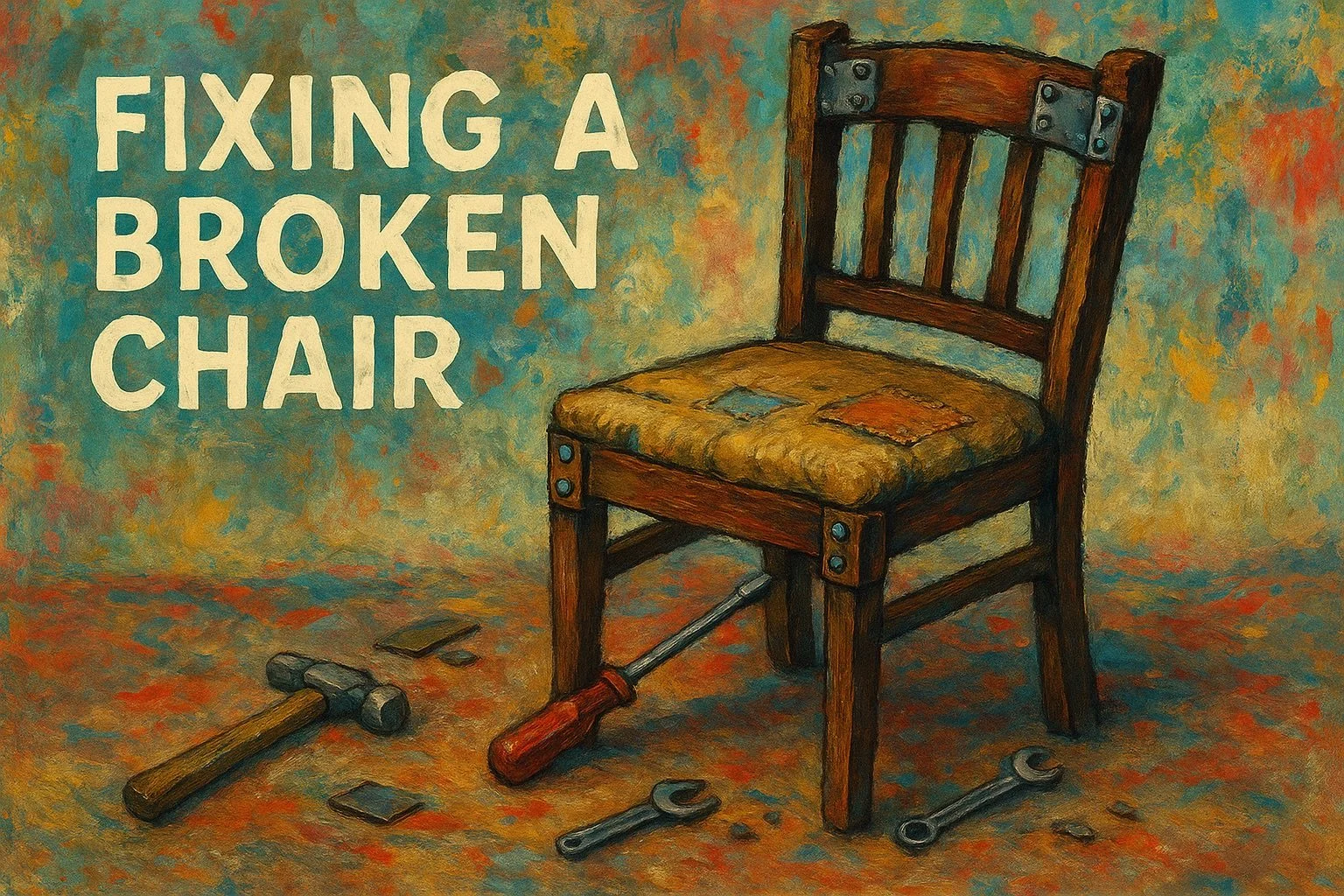
FIXING A BROKEN CHAIR
BUSINESS PLAN
FIXING A BROKEN CHAIR
Meditative Art Gallery and Studio
— Hangout and Paint —
Business Plan
Proposed location: 2 W Michigan Avenue, First Floor – The Sunburst
Ypsilanti, Michigan 48197
Prepared for the founder, prospective landlord, lenders, grant reviewers, and community partners
Initial comprehensive version • June 2026
A place to buy art, make art, sit with art, and see repair as part of the finished work.
Confidential planning draft • June 2026 • 1FIXING A BROKEN CHAIR | BUSINESS PLAN
Confidential planning draft • June 2026 • 2
Document status and planning basis
This plan is an initial comprehensive planning document. It is intended to support lease discussions,
lender conversations, grant applications, and internal operating decisions. Financial figures are
planning assumptions rather than promises. They must be updated after receiving a landlord term
sheet, utility history, contractor estimates, insurance quotes, and the final amount available after the
founder’s home sale.
Planning item
Founder
Opening location
Suite
Listed base rent
Startup cash
Debt assumption
Owner compensation
Initial staffing Founder only; Ruthie and family assistance as needed; paid
labor after revenue supports it
Gallery inventory
Alcohol
Target opening
Dependent on lease, funding, permits, and availability;
property listing indicates July 2026 availability
Contents
1. Executive Summary
2. Company Description
3. Founder and Competitive Advantage
4. Location and Market Opportunity
5. Customer Segments
6. Products and Services
7. Revenue Model and Pricing
8. Marketing and Sales Strategy
9. Operations and Space Plan
10. Management and Staffing
11. Legal, Licensing, Insurance, and Alcohol Controls
12. Startup Budget and Funding Request
13. Financial Projections and Break-Even
14. Grant and Capital StrategyFIXING A BROKEN CHAIR | BUSINESS PLAN
15. Launch Plan
16. Risk Analysis and Mitigation
17. Measures of Success
18. Landlord Proposal
19. Lender and Grant Case
20. Appendices and Source Notes
Confidential planning draft • June 2026 • 3FIXING A BROKEN CHAIR | BUSINESS PLAN
1. Executive Summary
Fixing a Broken Chair is a proposed owner-operated meditative art gallery, working studio,
participatory painting venue, and functional-art shop in downtown Ypsilanti. The business will sell
original artwork, reproductions, artist-designed clothing, and carefully selected refurbished
furniture while generating recurring cash flow through painting classes, open-studio sessions,
private parties, and corporate team-building events.
The concept is deliberately gallery-first rather than furniture-first. Refurbished furniture will be
presented as functional art and as evidence of the business’s central idea: visible repair, reuse,
imperfection, and transformation can add meaning rather than diminish value.
Primary brand: Fixing a Broken Chair
Subtitle: Meditative Art Gallery and Studio
Public invitation: Hangout and Paint
The proposed 2,000-square-foot Sunburst suite offers downtown frontage, natural light, high
ceilings, an open layout, ADA access, and rear access toward parking, Riverside Park, the Huron
River, and the Border-to-Border Trail. The property listing also seeks a performance-venue tenant,
making an interactive gallery with scheduled classes and events more compatible than a passive
retail gallery.
Business objective
The objective is to reach cash-flow break-even quickly, preserve working capital through an austere
MONK MODE operating philosophy, and build toward dependable owner income. The business will
not depend on unpredictable original-art sales alone. Paid experiences, private events, and
accessible products are designed to pay recurring expenses; originals and furniture provide brand
authority and higher-ticket upside.
Year-one priority Operating response
Immediate recurring income Launch with scheduled classes, open studio, and private-
event booking from the first month
Low owner cash contribution Pursue grants, a carefully structured loan, landlord
concessions, pre-sales, and used fixtures
No payroll burden Founder-operated with family assistance; hire only after a
documented revenue trigger
Low local household overhead Use minimal owner draws and reinvest cash during the
stabilization period
Strong differentiation Combine meditation-adjacent art experiences, UV/glow
painting, visible studio work, and functional-art furniture
Community fit Provide a welcoming downtown space that creates repeat
visits and evening activity
Confidential planning draft • June 2026 • 4FIXING A BROKEN CHAIR | BUSINESS PLAN
2. Company Description
Legal and ownership structure
The recommended initial structure is a Michigan limited liability company wholly owned by Allen
Six. Final tax treatment should be selected with a Michigan accountant. The company should
maintain separate banking, bookkeeping, insurance, contracts, and intellectual-property records
from the founder’s personal finances.
Mission
Fixing a Broken Chair creates a low-pressure art environment where people can browse, sit, paint,
recover attention, and purchase work shaped by repair, imperfection, and transformation.
Vision
To become a recognizable Ypsilanti creative destination: a place where people who do not identify
as artists feel permitted to make art, where original work remains central, and where the storefront
itself becomes a recurring subject for video, community events, and cultural participation.
Core values
Perfection in imperfection: mistakes are material, not failure.
Participation over intimidation: visitors may make art without prior skill or formal art-world
knowledge.
Repair over disposability: selected furniture and objects are restored, reimagined, and returned
to use.
Calm without pretension: meditative means attentive, low-pressure, and process-focused—not a
claim of clinical treatment.
Financial discipline: the company protects cash, avoids decorative overspending, and purchases
only what supports revenue or safety.
Owner authenticity: the founder’s work, methods, and story remain the primary creative
identity.
3. Founder and Competitive Advantage
Allen Six combines artistic production with practical repair ability, concept development, process
improvement, merchandising ideas, and long-form content planning. This mix allows the founder to
create inventory, teach experiences, repair fixtures and furniture, generate marketing content, and
operate the storefront without immediately hiring separate specialists.
Founder capability Commercial application
Original abstract artwork Primary gallery inventory and visual identity
Layered, glow, and UV concepts Distinctive ticketed classes and evening events
Furniture repair and refinishing Low-cost inventory acquisition and functional-art products
Hands-on construction and repair Lower fixture, maintenance, and buildout costs
Process and efficiency orientation Repeatable class setup, inventory controls, scheduling, and
cost discipline
Character and content development Future YouTube series, social content, clothing, and
merchandise
Confidential planning draft • June 2026 • FIXING A BROKEN CHAIR | BUSINESS PLAN
Founder capability Commercial application
Comfort with self-directed work Owner-operated launch model
MONK MODE commitment Minimal personal draw during the most fragile stage of the
business
Defensible difference
The business is not simply a gallery, paint-and-sip studio, thrift store, or rental studio. Its advantage
is the combination of a clear emotional metaphor, a visible working artist, accessible participation,
UV/glow programming, and curated repaired furniture. Customers can enter for different reasons
but experience one consistent idea: making and repairing are forms of acceptance. Hangout and paint is the draw, Perfection in Imperfection is the message.
4. Location and Market Opportunity
Proposed property
The Sunburst suite at 2 W Michigan Avenue is listed at approximately 2,000 square feet and $3,000
per month. The listing describes downtown-facing frontage, abundant natural light, exposed brick,
steel and concrete, ADA access, an open floor, high ceilings, parking access, and a rear connection
toward Riverside Park, the Huron River, and the Border-to-Border Trail. It also states that the suite is
seeking a performance-venue tenant and may be combined with adjoining space.
These features support gallery display, classes, after-hours events, video production, furniture
staging, and flexible reconfiguration. They also increase risk: high ceilings and a large open shell
may require more lighting, HVAC, acoustic treatment, and code-related work than a finished small
retail unit.
Local demand logic
Ypsilanti is a college-city environment within the larger Ann Arbor–Ypsilanti market. The customer
base includes students, young adults, families, local artists, downtown residents, visitors, employees,
and nearby higher-income households. Census QuickFacts reports a city median household income
of $46,588 for 2020–2024 and a poverty rate of 24.8%, indicating that accessible price points are
essential even while the broader regional market can support premium private events and original
art.
Market implication Business response
Price-sensitive local population Maintain $20–$35 entry experiences, small prints, and low-
cost add-ons
College and young-adult presence Offer evening glow events, date nights, open studio, and
social content
Families and nearby communities Offer parent/child sessions, private parties, and weekend
programming
Broader Ann Arbor-region purchasing power Market corporate events, collector originals, and premium
workshops regionally
Downtown cultural identity Participate in art walks, downtown events, and cross-
promotions
Park/trail access Use rear access and seasonal programming to capture
recreational foot traffic
Confidential planning draft • June 2026 • 6FIXING A BROKEN CHAIR | BUSINESS PLAN
Competitive position
The plan does not assume the absence of galleries, craft workshops, art centers, resale stores, or
paint-and-sip businesses. Instead, it competes through a hybrid format and a founder-led identity. A
formal competitive inventory should be completed within a 15-mile radius before financing closes,
comparing prices, calendars, capacity, customer reviews, parking, alcohol policies, and private-event
offerings.
5. Customer Segments
Segment Need Primary offer
Curious walk-ins An accessible reason to enter without
committing to a class
Gallery browsing, small prints, open
studio
Beginning adult painters Permission, structure, and low
pressure
Abstract beginner class; Hangout and
Paint
Couples and friend groups A social evening activity Glow/UV nights and paint-and-sip-
style events
Parents and children Shared creative activity Parent/child classes and parties
Art buyers Original work with a coherent story Small-to-signature original paintings
Home decorators Distinctive practical objects Refurbished and art-modified chairs
and tables
Event organizers A turnkey experience Private parties and custom sessions
Employers and teams A memorable group activity Corporate/team-building packages
Small creators, later phase Affordable production space Hourly creator corner or studio rental
6. Products and Services
Original artwork
Original artwork is the center of the brand, not a decorative side category. Inventory will include
small accessible pieces, medium and large originals, signature works, and selected not-for-sale
anchor pieces that establish the visual standard of the gallery.
Category Planned price range Role
Small originals $75–$300 Entry-level collecting and gifting
Medium originals $300–$900 Core gallery sales
Large originals $900–$3,500 Statement pieces and higher-margin
sales
Signature work $3,500+ Brand authority and collector
positioning
Not-for-sale anchors N/A Create identity and raise perceived
value
Reproductions and merchandise
Product Planned price Launch method
Small paper print $20–$35 On-hand limited assortment
Medium/large print $40–$150 Small batch and made-to-order
Confidential planning draft • June 2026 • 7FIXING A BROKEN CHAIR | BUSINESS PLAN
Product Planned price Launch method
Limited signed print $100–$500 Numbered releases
T-shirt/tote $25–$45 Samples plus print-on-demand or
preorder
Hoodie/premium apparel $55–$100 Small batch or preorder
Cards/stickers/small objects $4–$20 Impulse and gift purchases
Functional art and refurbished furniture
Furniture will be tightly curated to avoid turning the gallery into a crowded resale store. Chairs are
the signature category. Small tables, accent pieces, and repaired objects may be added when they
are visually distinctive, easy to move, or useful as gallery fixtures until sold. Heavy sanding,
stripping, spraying, and hazardous finishing should occur off-site or in a legally approved ventilated
work area; the public studio should be reserved for clean handwork, demonstrations, and light
assembly.
Classes and participatory experiences
Offering Initial price Suggested capacity
Hangout and Paint open studio $20–$35 6–18
Abstract painting for beginners $35–$55 8–16
Glow/UV painting $45–$75 8–16
Expressive/meditative painting $30–$55 6–14
Parent/child session $45–$70 per pair 6–10 pairs
Furniture painting/upcycling $75–$175 4–10
Private party $300–$900 minimum 8–24
Corporate/team-building $600–$1,500+ 10–30
The business will not claim to provide therapy unless a properly licensed professional is separately
engaged. “Meditative” and “expressive” refer to a calm, process-focused creative experience.
Creator studio rental
Creator rental is a later-stage add-on, not part of the opening break-even requirement. A small
lighting/backdrop area can first be used for the founder’s own video production. Once demand is
demonstrated, the business may rent it to small creators at approximately $25–$75 per hour, with
clear rules for noise, equipment, insurance, supervision, and after-hours access.
7. Revenue Model and Pricing
Recurring experiences are intended to cover fixed overhead. Retail, originals, and furniture
contribute gross margin and upside. This prevents the company from depending on rare large
purchases.
Revenue stream Year-one target share Margin character
Classes and open studio 35%–45% High contribution margin after
supplies
Private and corporate events 15%–25% High margin, labor-intensive,
bookable in advance
Confidential planning draft • June 2026 • 8FIXING A BROKEN CHAIR | BUSINESS PLAN
Revenue stream Year-one target share Margin character
Originals and prints 20%–30% High gross margin; uneven timing
Furniture 8%–15% Variable labor and inventory cycle
Apparel and small merchandise 5%–10% Moderate margin; keep inventory lean
Creator rental 0%–5% Later upside after demand validation
Pricing principles
Maintain an affordable entry point below $35.
Charge premium prices for UV/glow, furniture, private, and corporate experiences.
Require deposits for private bookings.
Price supplies, cleanup, setup, payment fees, and founder labor into every class.
Use bundles and memberships only after the single-session economics are understood.
Avoid discounting original work merely to create cash flow; use smaller formats and prints
instead.
Illustrative weekly schedule and revenue capacity
Activity Illustrative volume Weekly gross
Two beginner/expressive classes 10 attendees × $48 × 2 $960
One glow event 12 attendees × $62 $744
Open studio sessions 25 visits × $28 $700
One private booking Average $650
Gallery/print/apparel sales Average $1,000
Furniture/original sales Monthly average allocated weekly $650
Illustrative weekly total $4,704
At approximately 4.33 weeks per month, this schedule represents about $20,400 in monthly gross
revenue before refunds, seasonality, cost of goods, or taxes. It is an operating target, not a guarantee.
8. Marketing and Sales Strategy
Positioning statement
Fixing a Broken Chair is a downtown Ypsilanti gallery and working studio where people
can browse original art, sit down and paint without pressure, attend glow and beginner
classes, and find repaired objects with visible history.
Customer acquisition channels
Channel Purpose Priority
Storefront and window Convert foot traffic and explain the
concept in seconds Immediate
Google Business Profile Local discovery, hours, photos,
reviews, directions Immediate
Instagram/TikTok Short transformation and painting
videos Immediate
Facebook Events/Eventbrite Class and event discovery Immediate
Confidential planning draft • June 2026 • 9FIXING A BROKEN CHAIR | BUSINESS PLAN
Channel Purpose Priority
Email/SMS list Repeat attendance and private-event
offers Immediate
YouTube Long-form founder story and process
documentation Build steadily
Local press and downtown partners Opening awareness and credibility Launch
Employer outreach Corporate/team-building sales Month 2 onward
Hotel, restaurant, bar, and university
relationships Referrals and packaged events Month 2 onward
Content system
MONK MODE buildout: documenting disciplined creation of the space.
Before-and-after chair and furniture transformations.
“Painting for people who think they cannot paint.”
Glow-room reveals and event footage.
Mistakes incorporated into finished work.
Gallery work-in-progress and new original releases.
Customer work shown only with written permission.
Downtown Ypsilanti collaborations and event recaps.
Opening sales tactics
Publish the first six weeks of classes before opening day.
Sell founding paint passes and private-event deposits before the lease commencement when
legally appropriate.
Offer a limited founding print, not a permanent discount.
Capture contact information at every event and point of sale.
Request reviews immediately after successful classes.
Track acquisition source on every booking.
9. Operations and Space Plan
Proposed layout
Zone Approx. area Purpose
Front gallery and retail 550 sq. ft. Originals, prints, apparel, window
impact, checkout
Hangout and Paint area 600 sq. ft. Classes, open studio, private events
Functional-art furniture 275 sq. ft. Curated chairs/tables; movable
displays
Founder working studio/demo area 250 sq. ft. Production, demonstrations, content
Creator/video corner 125 sq. ft. Founder use first; later rentals
Storage, supplies, utility, circulation 200 sq. ft. Inventory, cleaning, packaging,
accessible paths
Confidential planning draft • June 2026 • 10FIXING A BROKEN CHAIR | BUSINESS PLAN
The design should use mobile easels, rolling partitions, stackable chairs, folding or modular tables,
track/grid hanging systems, curtains, and furniture that serves as both display and inventory.
Permanent construction should be minimized until the revenue pattern is proven.
Operating rhythm
Day Primary use
Monday Closed to public: sourcing, production, bookkeeping,
maintenance
Tuesday Gallery, open studio, content production
Wednesday Gallery plus beginner class
Thursday Gallery plus glow/UV event
Friday Gallery plus Hangout and Paint / adult social event
Saturday Gallery, parent/child or open studio, private evening event
Sunday Meditative session, private booking, reset; adjust after
demand data
Core systems
Cloud point-of-sale with item and event categories.
Online calendar, booking, deposits, waivers, cancellation rules, and capacity limits.
Per-event supply checklist and post-event profitability record.
Weekly cash-flow review and 13-week rolling forecast.
Photographed inventory with SKU, cost, labor estimate, asking price, and location.
Separate class supplies from retail inventory.
Daily opening/closing, cash, cleanup, and safety checklists.
10. Management and Staffing
The founder will initially serve as artist, instructor, buyer, furniture restorer, marketer, salesperson,
and manager. Ruthie and family may assist with setup, check-in, cleanup, and special events when
available. This keeps payroll low but creates founder-capacity risk.
Stage Staffing rule
Pre-opening Founder leads; use specialized contractors only for
licensed or code-sensitive work
Launch Founder operates most public hours and classes
Event support Family/Ruthie as available; paid temporary help only when
included in event pricing
First part-time hire Triggered by consistent demand, missed sales, or unsafe
workload—not optimism
Outside instructor Revenue-share pilot only after brand and quality standards
are documented
Hiring trigger
A part-time assistant should be considered when the business has at least eight consecutive weeks of
positive operating cash flow and the assistant’s hours can be supported by incremental revenue or
Confidential planning draft • June 2026 • 11FIXING A BROKEN CHAIR | BUSINESS PLAN
documented owner-capacity savings. A useful initial threshold is $20,000+ monthly revenue with
bookings that the founder cannot safely serve alone.
11. Legal, Licensing, Insurance, and Alcohol Controls
Before lease signing, the founder must obtain written confirmation that the premises may legally
and contractually support retail sales, art instruction, assembly events, private parties, light
furniture finishing, filming, signage, and the anticipated occupancy. The suite’s exact condition,
certificate of occupancy, fire capacity, restroom compliance, accessibility, HVAC, utilities, and tenant
improvement responsibilities must be verified.
Required diligence
Michigan LLC formation, EIN, sales-tax registration, local business requirements, and assumed-
name filings if applicable.
Commercial general liability, property/inland marine coverage, business interruption, product
liability, and workers’ compensation when required.
Participant waiver and photo-release procedures reviewed by counsel.
Written cancellation, refund, private-event, damage, and conduct policies.
Ventilation and hazardous-material controls for paints, solvents, UV equipment, and furniture
processes.
Music, video, and image rights compliance for public events and content.
Accessibility and safe aisle planning.
Alcohol strategy
The opening plan should not depend on alcohol revenue. The lowest-risk model is a partnership
with properly licensed local businesses or caterers. BYOB should be offered only after confirmation
from the landlord, insurer, local counsel, and relevant licensing authorities. Selling or serving
alcohol directly requires separate legal review and potentially Michigan Liquor Control Commission
approval. Public-property special events involving alcohol require additional approvals; private-
premises rules may differ.
12. Startup Budget and Funding Request
Lean startup budget
Use of funds Low Planning target
Lease deposit, first rent, legal review $6,000 $8,000
Essential code/buildout and repairs $3,000 $7,000
Gallery lighting and hanging system $2,500 $5,000
Tables, stackable chairs, easels,
storage $2,500 $4,500
Signage and window graphics $1,000 $2,500
POS, computer, printer, booking setup $1,000 $2,000
Initial class materials and safety
supplies $1,500 $3,000
Print/apparel samples and packaging $800 $1,500
Insurance, licenses, professional fees $1,200 $2,500
Confidential planning draft • June 2026 • 12FIXING A BROKEN CHAIR | BUSINESS PLAN
Use of funds Low Planning target
Opening marketing and photography $1,200 $2,500
Working-capital reserve $5,000 $10,000
Contingency $2,000 $3,500
Total $27,700 $52,000
The proposed $40,000 loan is therefore a midpoint, not an overfunded request. It becomes workable
only if buildout is limited, some fixtures are used or self-built, and the landlord provides concessions
or the founder receives grant reimbursement. A lender may also expect owner equity; the Michigan
SBDC notes that lenders often expect 20%–30% of startup cost as cash or equity investment. The
founder’s home-sale proceeds are not yet known, so the funding package must remain contingent.
Requested capital structure
Source Target Purpose
Founder cash $0–$5,000 initially Deposits and pre-opening items;
update after home sale
loan SBA microloan/CDFI/small-business
$40,000 Buildout, fixtures, equipment, launch,
reserve
Match on Main or similar grant Up to $25,000 reimbursement Eligible equipment, improvements,
marketing, or project costs
Landlord concession $6,000–$12,000 equivalent Free/ramped rent, TI allowance, or
completed shell work
Pre-sales/deposits $2,000–$8,000 Founding passes, private-event
deposits, limited print release
Debt assumption
The model uses a $40,000 loan at 11% annual interest over seven years, producing an estimated
monthly payment of approximately $685. SBA states that microloan rates generally range from 8%
to 13% and terms may extend to seven years. Actual approval, rate, fees, collateral, guaranty, and
payment will depend on the intermediary lender and borrower profile.
13. Financial Projections and Break-Even
The projections below are planning scenarios. They exclude income tax and sales-tax remittances,
and they assume the business is open for a full month after setup. They should be rebuilt from
actual class capacity, lease expenses, quotes, and opening date before submission to a lender.
Estimated monthly fixed operating expenses
Expense Monthly planning amount
Base rent $3,000
Loan payment $685
Utilities and waste $750
Insurance $350
Internet, phone, software $275
Marketing $600
Bookkeeping/professional fees $300
Confidential planning draft • June 2026 • 13FIXING A BROKEN CHAIR | BUSINESS PLAN
Expense Monthly planning amount
Maintenance/security/miscellaneous $300
Licenses and recurring compliance reserve $100
Fixed operating subtotal $6,360
Variable costs are modeled separately. A blended variable-cost assumption of 27% of revenue covers
paint and canvases, printing/apparel cost, payment processing, furniture materials, packaging,
refunds, and event-specific labor. Actual class margins should be tracked individually.
Break-even
At $6,360 in monthly fixed expenses and a 73% contribution margin, operating break-even before
owner draw is approximately $8,700 per month in gross revenue. Adding a $1,500 MONK MODE
owner draw raises the practical break-even target to approximately $10,800 per month. Adding a
$2,500 draw raises it to approximately $12,200 per month. Because seasonal volatility and repairs
are inevitable, management should treat $15,000 per month as the minimum stable target and
$20,000–$25,000 as the healthier range.
Monthly revenue level Approx. contribution after 27%
variable cost Result after $6,360 fixed cost
$10,000 $7,300 $940 before owner draw/tax
$15,000 $10,950 $4,590 before owner draw/tax
$20,000 $14,600 $8,240 before owner draw/tax
$25,000 $18,250 $11,890 before owner draw/tax
Year-one base-case ramp
Month Gross revenue target
1 $8,000
2 $10,000
3 $12,000
4 $14,000
5 $15,000
6 $16,000
7 $17,000
8 $18,000
9 $19,000
10 $20,000
11 $21,000
12 $22,000
This base case totals $192,000 in first-year gross revenue. At a 73% contribution margin,
contribution is approximately $140,160. After estimated fixed operating costs of $76,320, operating
cash flow before owner draw, tax, major capital purchases, and unforeseen repairs is approximately
$63,840. This result requires steady growth and is not guaranteed.
Scenario Year-one revenue Operating implication
Downside $120,000 Likely insufficient for reliable owner
Confidential planning draft • June 2026 • 14FIXING A BROKEN CHAIR | BUSINESS PLAN
Scenario Year-one revenue Operating implication
income; requires reserve, cost cuts, or
lease relief
Base $192,000 Supports lean owner draws and
reinvestment if margins hold
Growth $260,000 Supports hiring, reserve building, and
stronger owner compensation
Cash-control rules
Maintain a 13-week rolling cash forecast.
Do not treat sales tax as available cash.
Keep at least one month of fixed operating expense in reserve; target three months.
Delay owner draws when the reserve falls below the minimum.
Require private-event deposits and collect the balance before or at the event.
Review every class by attendance, gross sales, supply cost, setup/cleanup time, and contribution
margin.
Stop or reprice offerings that cannot reach contribution targets.
14. Grant and Capital Strategy
Grant funding should accelerate the launch but must not be assumed as guaranteed operating cash.
Match on Main is a reimbursement program of up to $25,000; approved expenses must generally be
paid and completed before reimbursement. The Ypsilanti DDA’s selection process emphasizes
district impact, alignment with strategic goals, project dependency, and catalytic benefit.
Grant narrative
Activates a prominent downtown storefront with daytime and evening uses.
Creates repeat foot traffic through classes rather than one-time retail visits.
Adds an accessible cultural experience and supports a creative district identity.
Converts a large suite into a flexible public-facing venue without requiring a conventional bar or
restaurant.
Supports reuse through refurbished furniture and low-waste fixtures.
Provides family, adult, private, and corporate programming.
Creates a platform for future small-creator production and community collaboration.
Funding sequence
1. 2. 3. 4. 5. 6. 7. Complete SBDC counseling and lender-ready projections.
Obtain landlord letter of intent and detailed occupancy-cost schedule.
Obtain quotes for code work, lighting, fixtures, insurance, and signage.
Apply for local and state grant opportunities before incurring ineligible costs.
Pursue SBA microloan/CDFI financing and compare full APR, fees, collateral, and prepayment
terms.
Negotiate landlord concessions before increasing debt.
Use pre-sales only after the opening timeline and refund terms are clear.
Confidential planning draft • June 2026 • 15FIXING A BROKEN CHAIR | BUSINESS PLAN
15. Launch Plan
Phase 0 — Validate before committing
Run at least three paid pop-up classes in Ypsilanti or the immediate market.
Test one glow/UV event and one beginner abstract event.
Collect emails, reviews, price objections, and repeat-interest data.
Sell a limited print or preorder apparel sample.
Document at least five furniture transformations.
Obtain preliminary private-party and corporate interest.
Phase 1 — Lease and funding diligence
Obtain a written landlord term sheet.
Confirm base rent, rent type, CAM, taxes, insurance pass-throughs, utilities, deposit, escalation,
and commencement date.
Confirm permitted uses, occupancy, alcohol/event restrictions, signage, hours, noise, furniture
processes, and filming.
Obtain contractor and insurance quotes.
Submit grants and financing applications.
Do not sign an unconditional long-term lease without a funded buildout and working-capital
plan.
Phase 2 — Build and presell
Install only essential code, lighting, storage, signage, and furniture.
Publish six weeks of programming.
Open private-event reservations.
Launch the founding print and paint-pass campaign.
Photograph the space and claim local listings.
Hold invitation-only practice sessions to test flow and cleanup.
Phase 3 — Opening and first 90 days
Soft opening with controlled capacity.
Opening gallery night and live painting.
Weekly beginner, glow, and open-studio programming.
At least two private bookings per month by Month 2.
Weekly financial and attendance review.
Adjust hours based on sales per open hour rather than habit.
Avoid adding creator rental, broad inventory, or employees until the core model is stable.
16. Risk Analysis and Mitigation
Risk Severity Mitigation
Five-year minimum lease High
Negotiate shorter initial term, options,
assignment/sublease rights, kick-out
provisions, or strong concessions
Rent type and pass-throughs unknown High Require full occupancy-cost schedule
Confidential planning draft • June 2026 • 16FIXING A BROKEN CHAIR | BUSINESS PLAN
Risk Severity Mitigation
and utility history before signing
Shell/buildout cost High
Inspect, obtain quotes, cap founder
work to lawful tasks, require landlord
completion or TI allowance
Insufficient founder equity High
Delay lease until home-sale position is
known; use grants/concessions/pre-
sales; reduce scope
Slow class demand High
Validate through pop-ups and
presales; adjust schedule and price
quickly
Owner burnout High
One closed production day, event
caps, documented setup, family help,
hire trigger
Art sales volatility Medium Use classes/events and accessible
prints as recurring revenue
Furniture crowding and slow turns Medium Limit quantity; use pieces as fixtures;
track days in inventory
Alcohol liability High
Do not rely on direct sales; use
licensed partners and written
approval
Seasonality Medium Corporate events, holiday gifts,
memberships, and reserve planning
Economic sensitivity Medium Maintain entry-level offerings and
strict fixed-cost controls
Brand confusion Medium Keep gallery-first signage; furniture
described as functional art
Go/no-go conditions for The Sunburst
Total recurring occupancy cost is documented and fits the financial model.
The suite can legally host planned classes and events at useful capacity.
Required buildout is fundable without consuming the operating reserve.
At least one month of fixed costs remains after opening purchases; three months is preferred.
The landlord provides meaningful concessions or the final capital package exceeds the current
$40,000 assumption.
Pop-up validation demonstrates paid demand.
The lease includes workable protection against a failed startup or material construction delay.
17. Measures of Success
Metric 90-day target 12-month target
Monthly gross revenue $12,000–$15,000 $20,000+ run rate
Class seat utilization 50%+ 65%+
Private bookings 2 per month 4–6 per month
Email/SMS list 500 1,500+
Google reviews 30 at 4.7+ average 100 at 4.7+ average
Repeat attendance 20% 35%+
Gross contribution margin 65%+ 70%+
Confidential planning draft • June 2026 • 17FIXING A BROKEN CHAIR | BUSINESS PLAN
Metric 90-day target 12-month target
Cash reserve 1 month fixed cost 2–3 months fixed cost
Owner draw Minimal, variable Stable bare-minimum draw with
growth path
18. Landlord Proposal
Fixing a Broken Chair should be presented to the landlord as an active creative venue that
complements the building’s intended arts ecosystem and generates repeat daytime and evening
visits.
Requested lease package
Two to four months of free or abated rent during permitting and setup.
Ramped rent during the first six operating months.
Landlord completion of base-building, code, HVAC, electrical, restroom, and life-safety
obligations.
Tenant improvement allowance or direct payment for agreed improvements.
Clear permitted-use language covering gallery, retail, art instruction, private events, filming, and
light clean furniture work.
Rights to exterior/window signage and event promotion.
Reasonable assignment/sublease and personal-guaranty burn-off provisions.
Delivery-date protection and rent commencement tied to legal occupancy.
Option periods rather than a long inflexible initial commitment where possible.
Landlord benefit
The business offers a coherent tenant identity, regular programming, visual storefront activity,
cross-promotion, and a concept naturally connected to repair and adaptive reuse. The owner-
operator will be physically present, maintain the space as a public-facing gallery, and build content
that repeatedly exposes the property and downtown Ypsilanti.
19. Lender and Grant Case
Why the plan merits financing
Multiple revenue streams reduce dependence on original-art sales.
The founder personally creates inventory and delivers the primary service.
Owner-operated staffing and MONK MODE reduce early cash demand.
The location supports retail, events, visibility, and content in one lease.
The startup budget prioritizes revenue-generating equipment and working capital rather than
luxury buildout.
Classes and private events can be presold and measured before full commitment.
The founder has practical repair and build skills that lower operating costs.
Why the project merits grant consideration
It activates downtown commercial space.
Confidential planning draft • June 2026 • 18FIXING A BROKEN CHAIR | BUSINESS PLAN
It creates recurring foot traffic and evening activity.
It contributes a distinctive arts identity rather than duplicating conventional retail.
It offers accessible public programming across age groups.
It supports reuse and visible repair.
It can catalyze collaboration with nearby businesses and downtown events.
Funding request summary
The initial request is for approximately $40,000 in debt financing plus the maximum eligible grant
and landlord contribution available. The final request may increase if required code/buildout work
or occupancy costs exceed current assumptions. Funds will be used for lease entry, essential
buildout, lighting, class equipment, signage, technology, launch inventory, insurance/professional
costs, marketing, and a protected working-capital reserve.
20. Appendices and Source Notes
Appendix A — Immediate action list
8. Contact the listing broker and request floor plan, shell-condition details, rent structure,
CAM/tax/insurance responsibilities, utility history, delivery condition, occupancy capacity, and
landlord work letter.
9. Register for no-cost Michigan SBDC counseling and request market research and lender-
readiness review.
10. Contact Ypsilanti DDA regarding current and upcoming Match on Main rounds and eligible costs.
11. Create a one-page founder resume focused on art, repair, operations, and instruction.
12. Create photographs and a catalog of existing originals, prints, apparel concepts, and furniture
transformations.
13. Run paid pop-up validation before executing the lease.
14. Obtain preliminary insurance, lighting, fixture, POS, signage, and code-work estimates.
15. Build a personal MONK MODE household budget to determine the exact minimum monthly
draw.
16. Update this plan when home-sale proceeds and landlord terms are known.
Appendix B — Questions that remain open
Exact personal cash available after the home sale.
Exact household minimum monthly cash requirement.
Final suite rent type and annual escalations.
Utility responsibility and historical cost.
Tenant-versus-landlord buildout responsibility.
Legal occupancy and event capacity.
Parking terms and customer access.
BYOB and alcohol partnership rules.
Opening date and construction timeline.
Actual demand measured through pop-up classes.
Confidential planning draft • June 2026 • 19FIXING A BROKEN CHAIR | BUSINESS PLAN
Appendix C — Source notes
LoopNet, “2 W Michigan Ave, Ypsilanti, MI 48197 – Flex for Lease,” listing updated May 4, 2026. Used for suite size, physical
features, access, and performance-venue positioning.
https://www.loopnet.com/Listing/2-W-Michigan-Ave-Ypsilanti-MI/37496414/
U.S. Census Bureau QuickFacts, Ypsilanti city, Michigan. Used for median household income and poverty data, 2020–2024.
https://www.census.gov/quickfacts/fact/table/ypsilanticitymichigan/PST045225
Michigan Economic Development Corporation, Match on Main. Used for program structure, up-to-$25,000 award level,
reimbursement-only structure, and program impact. https://www.miplace.org/small-business/match-on-main/
Ypsilanti Downtown Development Authority, Match on Main Grants. Used for local scoring considerations and local
administration context. https://ypsilantidda.org/match-on-main-program/
U.S. Small Business Administration, Microloans. Used for 8%–13% typical rates and maximum seven-year repayment term.
https://www.sba.gov/funding-programs/loans/microloans
U.S. Small Business Administration, 7(a) loan terms and eligibility. Used for maximum-rate framework.
https://www.sba.gov/partners/lenders/7a-loan-program/terms-conditions-eligibility
Michigan Small Business Development Center, Funding Your Small Business. Used for lender expectations concerning
owner equity and funding preparation. https://michigansbdc.org/management-tools/funding-your-small-business/
Michigan SBDC, no-cost consulting and business support services. https://michigansbdc.org/
City of Ypsilanti, Special Events Policy. Used only to identify that alcohol on public property requires licensing and
state/local approval; private-premises requirements require separate review.
The business is viable only as an active, scheduled creative venue—not as a gallery that
waits for buyers.
Confidential planning draft • June 2026 • 20
